
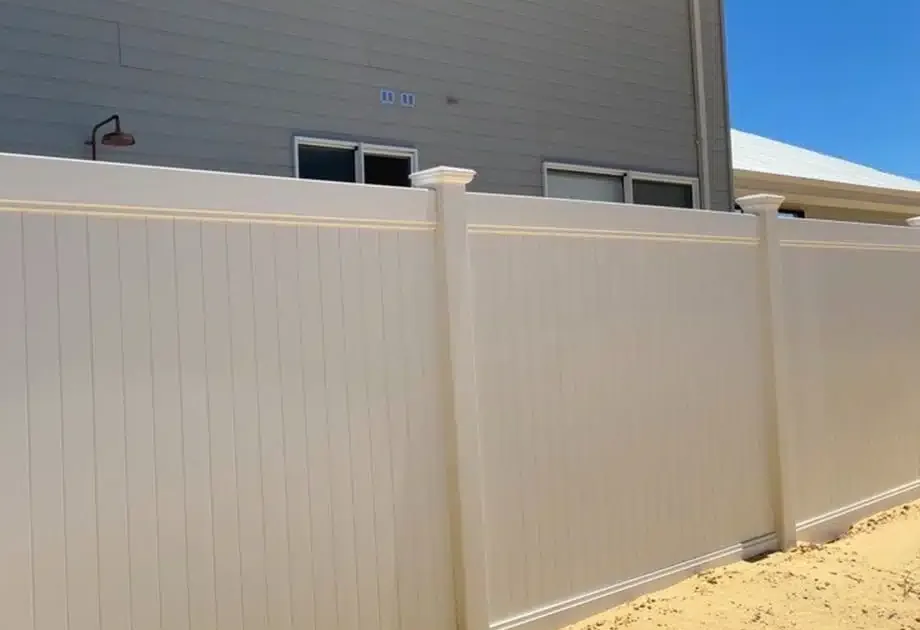
In WA, neighbours share the cost of a sufficient dividing fence half each under the Dividing Fences Act 1961. A sufficient fence is one your council's fencing local law lists, or one you and your neighbour agree on that does not break that law. So whether a white PVC boundary fence counts for the half share depends on your council, and the simplest path is to agree the fence in writing before anyone builds. White PVC is a good fit for a shared boundary: full privacy panels, no painting and a clean white finish.
Half each, but half of a sufficient fence
Section 7 of the Dividing Fences Act 1961 makes the owners of adjoining land liable to contribute in equal proportions to a dividing fence where there is no sufficient fence between them. Section 13 then lets the owner who built a sufficient fence claim half its value from the neighbour.
The word that matters is sufficient. The WA Government's dividing fences guide (updated 26 June 2026) says that if you build a fence of a higher standard than a sufficient fence before your neighbour agrees, you can only claim half the cost of a sufficient fence. Your neighbour's share is half of a sufficient fence, not half of the fence you chose.
What counts as a sufficient fence in WA
Section 5 of the Act gives four ways a fence can be sufficient:
- a fence your council's fencing local law prescribes for that part of the district
- a fence you and your neighbour agree on, as long as it does not fail to comply with that local law
- where there is no such local law or agreement, a substantial fence able to keep out cattle and sheep
- a fence the Magistrates Court decides is sufficient
Section 6 adds that the Act does not override an agreement between neighbours about the cost of a dividing fence. In practice, the agreement you sign with your neighbour is the strongest tool you have.
Is a PVC fence a sufficient fence? Your council decides
Each council writes its own list of sufficient fences for residential lots, and the lists differ on PVC. Three Perth examples, checked on 20 November 2026:
- Kalamunda lists a PVC fencing system up to 1.8 m high, installed to the manufacturer's specifications, as a sufficient fence on a residential lot (Fencing Local Law 2016, Schedule 1, item 6). The City gave notice in May 2026 that it is reviewing this law, so check the current version.
- South Perth lists timber, fibre cement or metal sheeting, brick or masonry and composite brick fences, and PVC is not on the list (Fencing Local Law 2024, Schedule 2).
- Canning lists timber, fibre cement or steel sheeting "or other non-permeable materials designed specifically for use as a fence", 1.8 m to 2.2 m high (Fencing Local Law 2021, Schedule 2). Ask the City whether a solid PVC privacy panel fits that wording.
Some councils leave room for other materials. The City of Bayswater, for example, lists its materials and then adds "a material approved by an authorised person". Your council's local laws page shows its fencing local law, and MyCouncil tells you which council covers your street.
When your council does not list PVC: agree it in writing
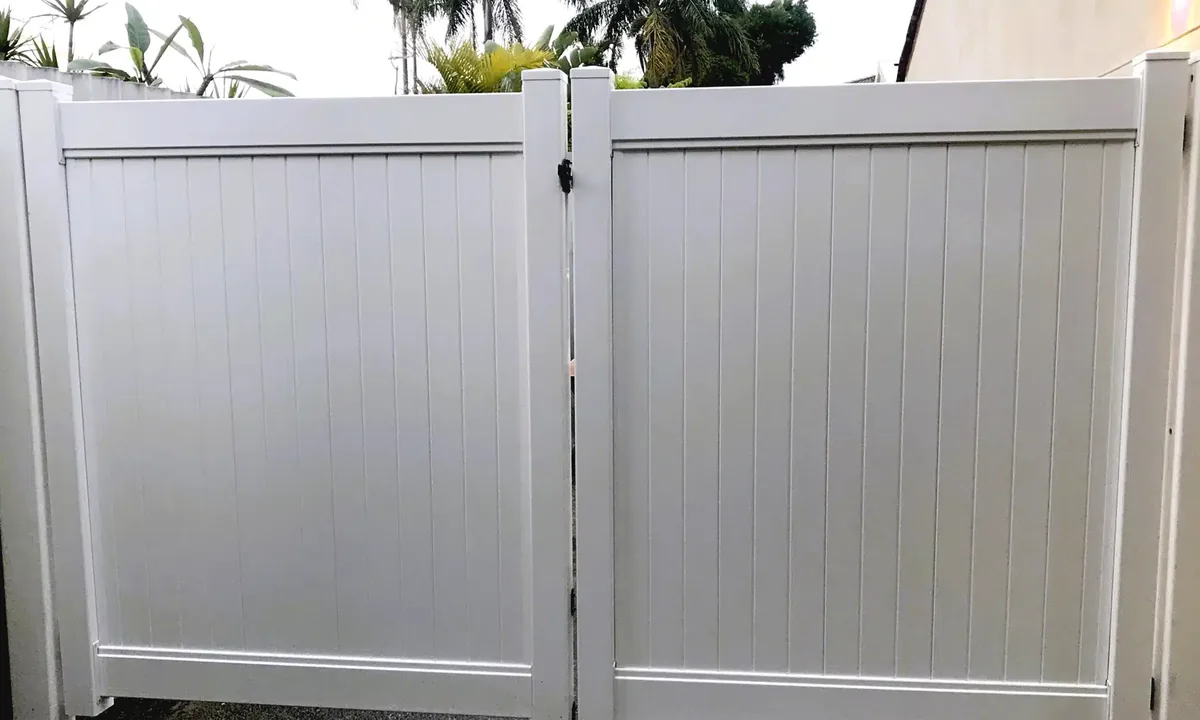
If PVC is not on your council's list, a white PVC fence can still be the fence you share, because an agreed fence counts as sufficient when it does not break the local law. Some local laws spell out the extra steps. In South Perth, a dividing fence that is not on the list is allowed where all owners agree in writing, it is no higher than 2.4 m and a structural engineer designs it, or where the City approves it or the court decides it is sufficient (clause 2.1). In Canning, the City can approve a fence that is not on its list when all the owners apply together (clause 2.2).
Put the split in that same agreement. For example, your neighbour might agree to pay half of what a listed fence would cost while you pay the rest for white PVC, or you might agree to share the PVC fence evenly. White PVC needs no painting and is low maintenance, which makes it an easy fence for two households to share. Write down whichever split you agree on.
How high can a boundary fence be in WA?
Usually 1.8 m, set by your council's fencing local law; the WA Government guide says height limits are set by councils in most cases. The state's Building Regulations 2012 (Schedule 4, item 4, as at 1 November 2026) say a fence needs no building permit when it is built to the council's fencing local law. Where a district has no such local law, a fence of a material other than masonry is exempt up to 1.8 m, masonry up to 0.75 m, outside wind regions C and D.
- South Perth sets 1.8 m for a sufficient dividing fence and measures it from the higher ground where the levels differ.
- Joondalup says dividing fences stand 1.8 m tall from natural ground level.
- Bayswater allows 1.8 m, and up to 2.1 m with the affected neighbour's consent; it says any fence over 1.8 m needs a building permit, and Mosman Park says the same.
Front fences follow different rules near the street. Our guide to front fence rules in Perth covers the 1.2 m line and driveway sightlines.
The written notice and the 21 days
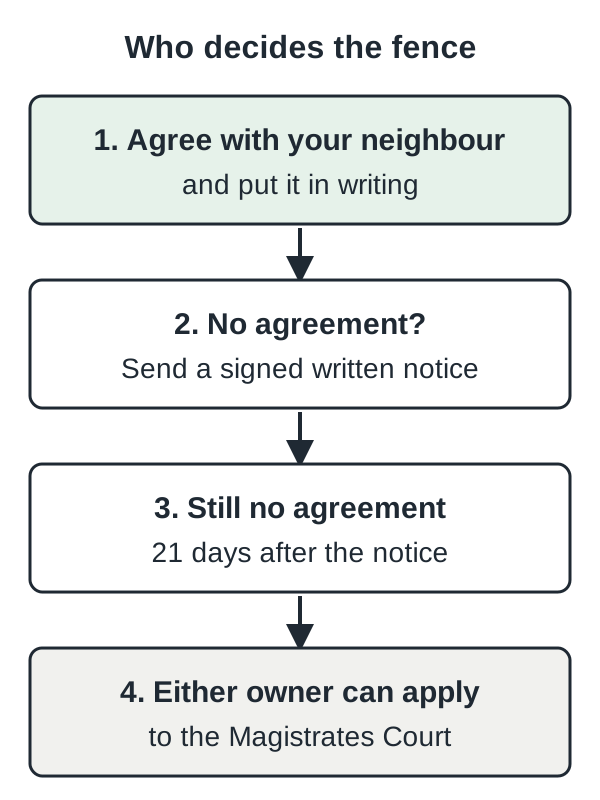
If a friendly conversation does not settle it, the Act gives you a written notice. Under section 22 it must be in writing, signed, and delivered in person or by registered mail, and under section 8 it names the boundary, your proposal and the kind of fence. The WA Government guide suggests it also covers:
- the type of work: a new fence, a repair or a realignment
- the kind of fence and its material, for example white PVC
- who will organise the work
- where the fence will go, especially if it is off the boundary line
- how the cost will be paid and shared
If you still disagree 21 days after the notice about the need for the fence, the line or the kind of fence, either owner can apply to the Magistrates Court (section 9). The court is guided by the fences usual in the area, how the land is used and the council's sufficient fence, and its order is final. Once a fence is agreed or ordered, if one owner does not do their part within the time set, or within 3 months, the other owner can build the whole fence and recover half the cost (section 10).
Not sure where the line is? Under section 12, you can give notice that you want a surveyor to define it. Your neighbour then has 7 days to mark the line with pegs or engage a surveyor. If, a month after your notice, they have only pegged it or have not had it surveyed, you can have a surveyor define it. If the survey puts the line where their pegs were, you pay for the survey; otherwise you share the cost.
What to send for a quote your neighbour can agree to
The WA Government guide notes that quotes help neighbours reach agreement. A quote that sets out the white PVC fence, its height and where it runs gives your neighbour something concrete to agree to, and you can attach it to the agreement or the notice. When you ask for a quote, send the length of the boundary, the height you have agreed, the panel you prefer (full privacy or semi-privacy with an open top), any change in ground level along the line, your suburb and a photo of the old fence.
One customer review on our site sums up the finish: "Great quality PVC fencing. The guys were very professional and the site was left clean."
Get a quote for your boundary fence
Send the fence type (full privacy or semi-privacy), the boundary length, the height you have agreed, your suburb and a photo of the old fence. We will come back with a quote you can share with your neighbour.
Prefer to talk it through? Call Primed PVC Fencing Perth on (08) 9930 6317, or see our range of white PVC fencing in Perth.
This guide is general information about WA law, not legal advice. Laws and council pages were checked on 20 November 2026. For a dispute, Legal Aid WA lists where to get help, including paid mediation through Citizens Advice Bureau WA.
Frequently asked questions
Does my neighbour have to pay half of a new fence in WA?
Usually half of a sufficient fence, under sections 7 and 13 of the Dividing Fences Act 1961. If you build a higher standard fence before they agree, the WA Government guide says you can only claim half the cost of a sufficient fence.
Do I have to tell my neighbour before I put up a fence?
If you want your neighbour to share the cost, yes: agree it first or give a signed written notice under section 8. If you build first and claim later, you can only claim half the value of a sufficient fence, and they have one month to dispute the claim (section 13).
Is a PVC fence a sufficient fence in WA?
It depends on your council. Kalamunda's fencing local law lists a PVC fencing system up to 1.8 m; South Perth's list does not include PVC. Where PVC is not listed, a white PVC fence you and your neighbour agree on in writing can still be the fence you share, subject to the local law's conditions.
What is the maximum height for a boundary fence in WA?
Usually your council's fencing local law sets it, and most councils checked use 1.8 m; Canning's list allows 1.8 m to 2.2 m, and Bayswater up to 2.1 m with the neighbour's consent. Where a district has no fencing local law, a fence needs a building permit if it is over 1.8 m, or over 0.75 m for masonry, or sits in wind region C or D.
What happens if my neighbour and I cannot agree?
Send a signed written notice. Before going to court you can try mediation; Legal Aid WA lists Citizens Advice Bureau WA, which charges for it. If you still disagree 21 days after the notice, either owner can apply to the Magistrates Court, which decides the fence, and its order is final.